Best Trucks for Towing a Boat in 2026
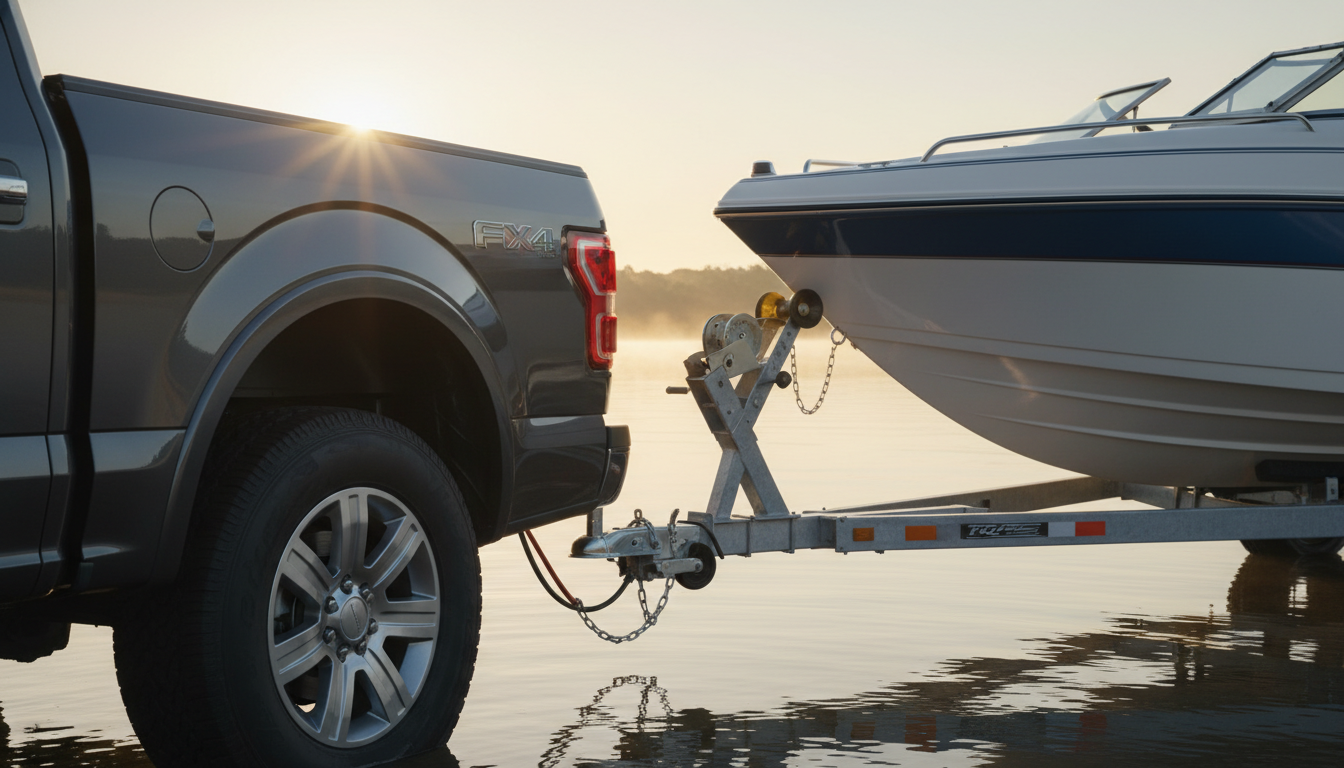
Half-ton trucks handle most recreational boats without breaking a sweat—but pick the wrong configuration and you’ll be undertrucked at the boat ramp. Here’s how the best current options stack up across payload, tow rating, and real-world usability.
What “Best for Boat Towing” Actually Means
A boat tow isn’t like hauling a fifth-wheel. The weight is usually lower, but the load sits further back on a trailer, which amplifies tongue weight and sway. You want a truck with a high enough tow rating, sufficient payload for tongue weight plus gear, and ideally an integrated trailer brake controller and sway control compatibility.
Gross Combined Weight Rating (GCWR) and payload are both limits you cannot ignore. A truck rated at 13,000 lbs towing capacity can still be overloaded if its payload is 1,400 lbs and your tongue weight is 1,200 lbs before you add a passenger or cooler.
Ford F-150 — Best Half-Ton Overall
The F-150 with the 3.5L PowerBoost hybrid or the standard 3.5L EcoBoost pulls up to 14,000 lbs in the right configuration. For most boat owners—bass boats, ski boats, 24-foot pontoons—that’s more than enough ceiling.
What makes it the default pick is the Pro Trailer Backup Assist, available trailer profiles you can save, and a rearview camera that actually shows trailer sway in real time. The onboard scale via FordPass tells you your remaining payload before you hook up, which matters when your boat trailer has a heavy winch post and full livewells.
Spec it with the Max Trailer Tow Package, which adds a Class IV receiver, upgraded cooling, and 4.10 rear axle. Without that package, tow ratings drop significantly.
Ram 1500 — Best Ride Quality for Long Hauls
If you’re towing a boat more than 200 miles at a stretch—lake house trips, tournament weekends—the Ram 1500’s coil-spring rear suspension makes a real difference. It’s the only half-ton with that setup, and it absorbs road imperfections better than leaf-spring competitors.
The 3.0L Hurricane twin-turbo inline-six (replacing the old eTorque options) delivers strong torque at low RPM, which helps on steep ramp exits. Tow ratings hit around 12,700 lbs depending on cab and bed config.
The Ram’s weak point is payload—some configurations dip below 1,500 lbs, so run the math on your tongue weight before you assume it fits your rig.
Chevy Silverado 1500 — Best Value Configuration
The Silverado doesn’t lead in any single category, but it hits a strong balance of tow rating (up to 13,300 lbs with the 6.2L V8 or 3.0L Duramax diesel), payload, and price. The 3.0L Duramax inline-six diesel is worth considering if you tow frequently—better fuel economy under load and strong torque from idle.
The Trailer Side Blind Zone Alert and integrated brake controller are standard on higher trims. For a 25-foot bowrider or a heavy tritoon, a well-specced LTZ or High Country with the Duramax is hard to argue against.
Silverado pricing tends to undercut Ford and Ram on similarly equipped trims, which matters if you’re buying with cash or keeping payments lower.
When to Step Up to a Three-Quarter-Ton
If your boat-and-trailer combo exceeds 10,000 lbs wet—large pontoons, offshore center consoles, ski boats with big twin-axle trailers—look at the Ford F-250 with the 6.7L Power Stroke, Ram 2500 with the 6.7L Cummins, or Silverado 2500HD with the 6.6L Duramax.
These trucks aren’t overkill for big boats. They’re the right tool. Payload jumps to 2,000–4,000 lbs depending on config, and conventional tow ratings start around 17,000 lbs. You also get larger factory sway control provisions and heavier-duty cooling systems that don’t work as hard on grades.
The tradeoff: fuel economy drops, ride is stiffer, and parking at the ramp gets trickier with a long wheelbase crew cab.
Key Specs to Check Before You Buy
Don’t buy on tow rating alone. Pull the window sticker or build sheet and verify:
- Max payload (yellow sticker inside driver’s door jamb)
- Tongue weight limit (usually 10–15% of tow rating)
- Receiver class (Class IV is standard; Class V on HD trucks)
- Integrated trailer brake controller (included or dealer add)
- Axle ratio (4.10 beats 3.31 for towing)
Also confirm the tow rating is for the specific cab, bed length, engine, and drivetrain you’re buying—not just the “up to” headline number.
Hitch Setup Matters as Much as the Truck
A great truck with a poor hitch setup is still a handling problem. For boats over 6,000 lbs, run a weight distribution hitch—the Equal-i-zer 4-Point or Blue Ox SwayPro are solid options—even if the truck can technically handle it without one. Sway at highway speed with a top-heavy pontoon or cuddy cabin is not a situation you want to manage reactively.
Make sure your ball mount drop matches the coupler height on your boat trailer. A mismatched setup puts the trailer tongue at an angle that shifts weight distribution and increases sway risk.
Bottom line: For most boat owners, a properly specced F-150 or Silverado 1500 diesel is the right call. Step to a 3/4-ton only when your rig genuinely needs it—and always verify payload before the dealer order, not after delivery.