Best SUVs for Towing a Camper (2026 Picks)
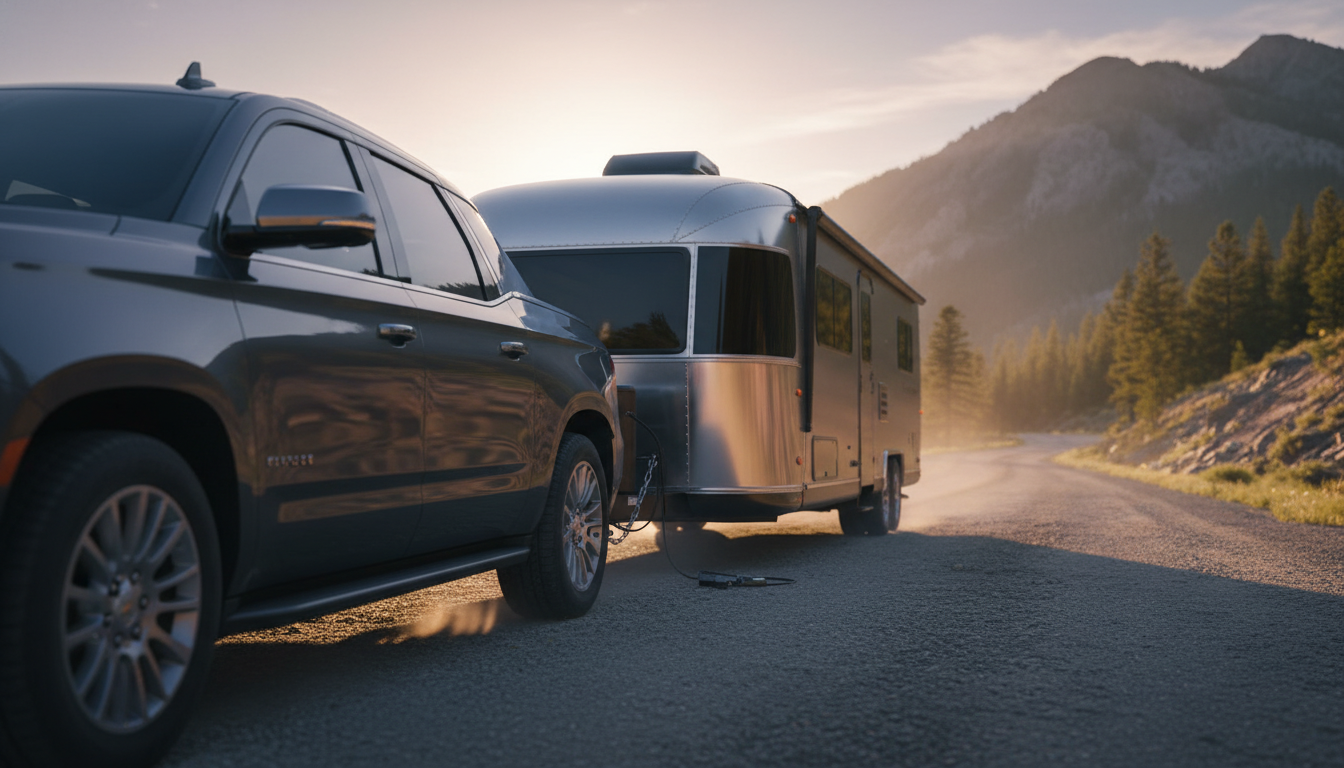
Most SUVs can tow something. Far fewer can tow a camper without beating up the drivetrain or leaving you white-knuckling mountain grades. These picks are rated on actual tow capacity, payload margin, powertrain reliability, and how well they handle the real load — not the optimistic number on the window sticker.
What Makes an SUV Actually Good for Camper Towing
Tow rating gets all the attention, but payload is the number that bites people. Payload covers your passengers, cargo, tongue weight, and any gear in the vehicle. A mid-size SUV rated at 5,000 lbs tow capacity might carry only 1,100 lbs of payload — meaning a 500 lb tongue weight alone eats nearly half your budget before anyone sits down.
The other factor is transmission cooling and gear ratio. SUVs with purpose-built tow packages include transmission oil coolers, engine oil coolers, and trailer-sway control calibrated for a loaded hitch. Without those, you’re using the base setup — and base setups run hot on mountain passes with 6,000 lbs behind them.
Prioritize:
- Tow rating at least 20–30% above your loaded camper weight
- Payload of 1,400 lbs or more for real-world use
- Factory tow package (not an aftermarket add-on)
- Integrated trailer brake controller (increasingly standard above $45K)
Ford Expedition: The Benchmark for Full-Size SUV Towing
The Expedition tops most lists for a reason. With the available 3.5L EcoBoost V6, it pulls up to 9,300 lbs — enough for most fifth-wheel-style toy haulers and almost any travel trailer. More importantly, payload on properly optioned trims runs 1,600–1,900 lbs, which gives you genuine headroom.
The Max wheelbase variant adds cargo space without meaningfully changing the tow numbers. The factory tow package is mandatory if you’re pulling anything over 5,000 lbs — it adds the transmission cooler, upgraded hitch receiver, and wiring for a 7-pin connector. Skip it and you’re leaving engineering on the table.
One honest downside: fuel economy drops to 12–14 mpg at highway speeds with a trailer. Budget accordingly.
Chevy Tahoe / GMC Yukon: Proven Platform, Know the Trim Differences
The Tahoe and Yukon share the same platform and powertrain. The 5.3L V8 is rated up to 8,400 lbs tow capacity on properly equipped trims; the 6.2L V8 bumps that to 8,500 lbs with marginally better passing power on grades. Both have a track record that spans decades of camper duty.
What catches buyers off guard is how much tow capacity varies by trim and configuration. A base LS with 2WD will have a different GVWR than a 4WD High Country — and that changes your payload ceiling significantly. Always pull the specific build’s tire placard and GVWR before assuming the advertised max applies to your truck.
The Max Trailering Package is non-negotiable for serious use. It adds a larger cooling package, a 4.10 rear axle, and wiring upgrades. Without it, you’re at the casual-towing setup.
Ford Explorer ST: Mid-Size Option for Lighter Trailers
If your camper is a lightweight travel trailer — think teardrop or small hybrid like an Airstream Bambi 16 or Lance 1685 — the Explorer ST earns a look. Rated at 5,600 lbs tow capacity with the 3.0L EcoBoost, it handles lighter loads confidently without the fuel and parking penalty of a full-size.
Payload is tighter here, typically around 1,200–1,400 lbs depending on options. That’s workable if you’re carrying two adults and keeping tongue weight under 500 lbs. Push past those limits and the Explorer will remind you it’s a crossover with SUV ambitions, not a truck-based hauler.
The integrated trailer brake controller on ST trim and above is a genuine convenience, and Ford’s Pro Trailer Backup Assist is worth having if you’re parking in campgrounds regularly.
Toyota Sequoia: Reliability Reputation with Hybrid Efficiency
The Sequoia went full hybrid in 2022 with a 3.4L twin-turbo V6 paired to an electric motor. Tow rating hits 9,000 lbs, and the twin-turbo torque delivery is smooth under load. The hybrid system adds low-end torque that helps when you’re pulling onto the highway or climbing grades.
Real-world fuel economy towing is notably better than the competition — owners report 13–16 mpg with moderate loads where comparable V8 rigs run 11–13. Over a season of trips, that gap adds up.
Payload is the caveat. The Sequoia’s curb weight is high, which trims payload to the 1,200–1,500 lb range depending on trim. Manage your tongue weight carefully. The Platinum and Capstone trims add air suspension, which helps self-leveling under load — a legitimate feature if you’re towing frequently.
Jeep Grand Wagoneer: High Tow Rating, Know the Payload
The Grand Wagoneer’s 6.4L V8 (Series I and II) is rated at up to 9,850 lbs — competitive with any full-size SUV on the market. The powertrain is capable, the towing electronics are well-developed, and the integrated display shows trailer camera feeds and leveling data that Class A drivers get used to expecting.
Payload runs around 1,300–1,600 lbs. The truck-based body-on-frame construction helps, but the premium interior equipment adds curb weight that works against you.
Reliability on the 6.4L Hemi in Jeep/Ram applications has been acceptable but not Toyota-tier. If you’re putting 20,000+ miles of towing duty on it annually, factor that into your ownership calculus.
Bottom Line
For most camper-towing needs above 5,000 lbs, the Ford Expedition and Chevy Tahoe with their respective max trailering packages are the safest bets — proven powertrains, high payload ceilings, and wide dealer support. If you’re pulling under 5,000 lbs and want better fuel economy, the Explorer ST or a well-configured Sequoia gets the job done without the full-size footprint. Match your specific camper’s loaded tongue weight and GVWR to the SUV’s payload spec first — that single calculation prevents more towing problems than any other research step.